AC and Water Heater Replacement Costs: What to Expect Before You Call
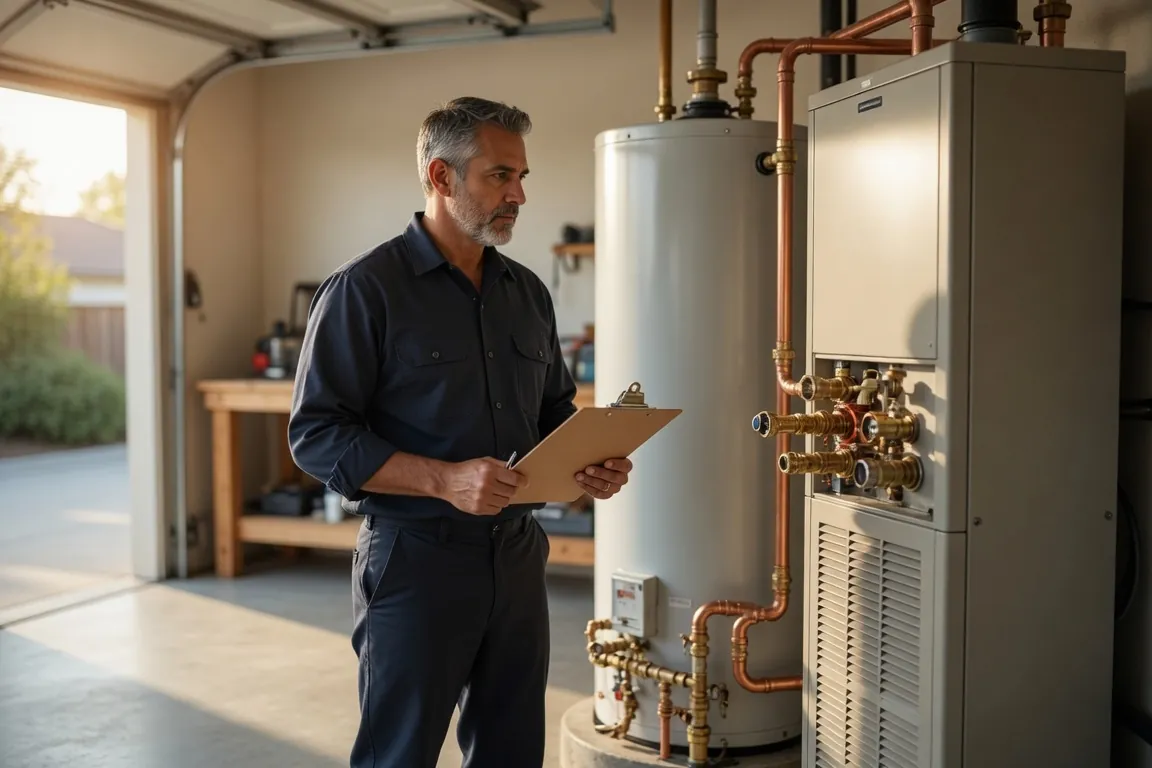
The questions below are the ones people ask first when something stops working and they realize they have to spend serious money. The answers cover the cost ranges, the practical decisions, and where a home warranty plan does and does not help. The numbers are 2026 figures from the major HVAC and plumbing trade groups; your local market may run higher or lower depending on labor rates and equipment availability.
Here are the 2026 numbers at a glance before we get into the specifics, so you have the lay of the land.
| Replacement job | Typical 2026 installed cost | What drives the range |
|---|---|---|
| Tank water heater (40 to 50 gal, gas or electric) | $1,200 to $2,800 | Unit, labor, disposal, and code-required updates |
| Tankless gas water heater | $3,000 to $6,500 | Added venting and gas line work |
| Heat pump (hybrid) water heater | $2,500 to $5,500 | Rebate-eligible; needs airflow and drainage |
| Water heater labor only (gas swap) | $500 to $1,200 | Plus a $50 to $300 permit where required |
| AC compressor replacement | $1,500 to $3,200 | Single-stage vs variable-speed; refrigerant type |
| New central AC (2,000 sq ft, 3 to 4 ton) | $5,500 to $11,500 | Equipment tier, brand, and SEER rating |
| Heat pump system (2,000 sq ft) | $8,000 to $16,000 | Both heats and cools |
*Figures are 2026 ranges from Angi, HomeGuide, the ENERGY STAR water heater program, and the U.S. Department of Energy's central air conditioning guidance. Local labor rates and code upgrades move these a lot, so get an itemized quote to confirm current pricing.
Common questions
What's the average cost to swap out a water heater?
A standard 40 to 50 gallon gas or electric water heater replacement runs $1,200 to $2,800 installed in most US markets in 2026, including the unit, labor, disposal of the old tank, and code-required updates (expansion tank, drain pan, earthquake straps in seismic zones). Tankless gas water heater installations run $3,000 to $6,500 because of additional venting and gas line work. Heat pump water heaters (rebate-friendly in many states, and recognized for efficiency through the ENERGY STAR program) run $2,500 to $5,500 installed. If your home warranty plan covers water heaters, the typical coverage applies after the deductible/service fee and reimburses the equipment cost up to a per-event cap, leaving you responsible for code upgrades and most labor overages.
What is the average labor cost to install a 50 gallon gas water heater?
Labor for a like-for-like 50-gallon gas water heater swap runs $500 to $1,200 in most US markets in 2026, separate from the unit itself ($600 to $1,200 retail). The wide range is mostly local market labor rates and whether code updates are needed. A simple swap with no permit needed takes a competent plumber three to five hours including gas line connection, venting check, and disposal of the old unit. Permit and inspection add $50 to $300 depending on jurisdiction. If you are quoted under $400 in labor on a gas unit, ask whether the plumber is pulling a permit; unpermitted gas work creates a fire-insurance and resale problem you do not want.
Why do plumbers charge so much to replace a water heater?
Three reasons drive the bill higher than the equipment cost suggests. First, gas water heaters require a licensed plumber in most jurisdictions because the gas connection, venting, and combustion air requirements are life-safety code items; unlicensed installs are illegal and uninsurable. Second, the swap typically triggers code-required updates a previous owner avoided: expansion tank ($200), drain pan ($150), earthquake straps ($75), upgraded venting ($300 to $800), seismic gas shutoff ($300). Third, the disposal fee for the old unit, the permit fee, and the truck-roll labor minimum all add fixed costs. The unit alone is often less than half the bill. A reputable plumber will itemize each line.
How many years does a hot water heater typically last?
A standard tank-style gas or electric water heater lasts 10 to 13 years in most US homes; the manufacturer's warranty (6, 9, or 12 years depending on tier) is a reasonable lower bound. Tankless units last 18 to 25 years with annual descaling maintenance. Hard water shortens both significantly; soft water extends them. The most common failure modes: the anode rod gets consumed (replaceable, $150 to $300, doubles unit life if done at year five), the tank rusts from the inside (terminal), or the gas valve fails (repair sometimes economical on units under eight years). If your tank is 12 or more years old and starts making popping sounds or shows rust at the connections, plan the replacement now rather than after the leak.
Is it worth replacing an AC compressor?
It depends on the age of the system. If the AC is less than seven years old and otherwise sound, replacing the compressor (typically $1,500 to $3,200 installed) often makes sense. Beyond ten years, replacing only the compressor sets you up to spend the same money again on a different failed component within two to three years. The HVAC trade calls this the $5,000 rule (sometimes the 5,000 rule): if the system is older than 10 years and the repair quote exceeds $5,000, replace the whole unit. The compressor itself is typically the most expensive single component, so a failed compressor on an older system usually pushes you over the threshold.
How much does it cost to replace an AC compressor?
Compressor replacement runs $1,500 to $3,200 installed in 2026 for a typical residential 2 to 4 ton central AC. The range is driven by compressor type (single-stage versus two-stage versus variable-speed), refrigerant type (R-410A is being phased out and replaced by R-454B starting 2025, which affects pricing), and labor rates. If your system is under warranty for the part (10-year compressor warranties are common on Trane, Carrier, Lennox), you pay only the labor and refrigerant, dropping the bill to $500 to $1,200. Always check the manufacturer warranty before paying full price; the original installer's records or the model and serial number lets the manufacturer's customer line tell you the warranty status in five minutes.
How do I tell if my AC compressor is bad?
The most reliable signs: the system blows warm air even when set to cool and the thermostat shows a long runtime, the outside condenser unit hums but the fan does not spin, the circuit breaker for the AC trips repeatedly within minutes of starting, or you hear a hard-start-and-stop clunk from the outside unit. A failing capacitor produces some of the same symptoms but is a $200 repair, so a competent HVAC technician will test the capacitor first before condemning the compressor. If a technician says "compressor is bad, replace the whole unit" without testing the capacitor and the start relay, get a second opinion. The cost difference between a $200 capacitor and a $5,000 unit replacement is worth twenty minutes.
What is the $5000 AC rule?
The $5,000 rule, sometimes called the 5,000 rule, is an HVAC industry rule of thumb: multiply the system's age in years by the repair cost in dollars. If the result exceeds 5,000, replace the entire system instead of repairing. A ten-year-old system needing a $600 repair = 6,000, replace. A four-year-old system needing a $1,000 repair = 4,000, repair. The rule is rough but generally correct because older systems pile up repairs and become less efficient than current models, which can lower annual operating cost by 20 to 40 percent. The rule assumes the equipment is reaching the back end of its useful life. For unusual brands or commercial-grade home systems, the rule needs adjustment.
How much is a new air conditioner for a 2000 sq ft house?
A new central AC system for a 2,000 square foot single-story home typically requires a 3 to 4 ton unit, which prices at $5,500 to $11,500 installed in 2026 for a standard single-stage condenser plus air handler, including ductwork connections, refrigerant line set, electrical, condensate drain, and permit. The wide range reflects equipment tier (single-stage versus two-stage versus variable-speed inverter), brand (entry-level Goodman or Rheem versus premium Trane or Carrier), and local labor rates. Heat pump replacements (which both cool and heat) typically run $8,000 to $16,000 installed for the same square footage. Get three written quotes specifying brand, model number, tonnage, and SEER rating before signing.
Is it cheaper to repair or replace an AC unit?
Use the $5,000 rule as a starting point, then factor in three more considerations. First, refrigerant: if your system uses R-22 (phased out in 2020), refrigerant cost has climbed to $100+ per pound, making repairs expensive on older units. Second, efficiency: a 15-year-old AC running SEER 10 versus a new SEER 16 unit will cost roughly 40 percent more in electricity each summer (the Department of Energy covers how efficiency ratings affect operating cost). Over a 10-year horizon, that operating cost difference often dwarfs the install cost. Third, reliability: an older unit with one failed component usually has more failures queued up. A home warranty can defray the replacement cost but rarely covers the whole bill; read your plan's per-event and lifetime caps before relying on it.
Can a home warranty soften these numbers before something fails?
Only if it is in place before the failure, since every plan excludes pre-existing conditions and carries a roughly 30-day waiting period. If your AC or water heater is aging but still healthy, this is the window where coverage is actually buyable. → Get a Choice Home Warranty quote. HVAC is in the base plan with about a $3,000 per-item cap. Compare that cap against the replacement prices above; it will not cover a premium install, but it changes what a bad month costs.